Hwadar Fiberglass Satellite Antennas: Technical Characteristics and Engineering Applications
Hwadar Fiberglass Satellite Antennas: Technical Characteristics and Engineering Applications
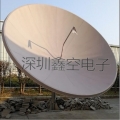
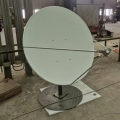
In the fields of broadcast front-end equipment and satellite reception engineering, the material of the antenna reflector directly determines the long-term stability and signal quality of the system. As a veteran enterprise in China's communication products sector, Hwadar has established a strong reputation since its establishment in 1988. Its flagship SMC (Sheet Molding Compound) fiberglass satellite antennas are highly regarded in the industry. This article provides a comprehensive technical analysis of Hwadar fiberglass satellite antennas for site technicians, covering material processes, technical specifications, and engineering deployment.
Core Material and SMC Molding Process
The reflector of Hwadar fiberglass satellite antennas is manufactured using SMC, a composite material consisting of unsaturated polyester resin and glass fiber reinforcement. Its mechanical strength is comparable to standard carbon steel.
During manufacturing, Hwadar employs high-temperature and high-pressure molding technology. Unlike traditional stamped metal plates or hand-laid processes, SMC molding eliminates spring-back after demolding, ensuring that dimensional accuracy is entirely guaranteed by the mold. This process endows the antenna with the "Three Highs" characteristics: High Precision (RMS surface accuracy within 0.35mm for solid panels and under 0.6mm for multi-piece assemblies), High Efficiency (antenna efficiency of 60%-70%), and High Gain. Furthermore, the antenna's reflective layer utilizes a dense aluminum mesh that is tightly embedded during the molding process. This not only ensures highly efficient electromagnetic wave reflection but also isolates the internal structure from atmospheric corrosion.
Exceptional Weather Resistance and Mechanical Strength
Traditional aluminum antennas often suffer from severe salt spray corrosion in coastal or acid-rain-prone areas. In contrast, SMC fiberglass antennas demonstrate superior anti-corrosion capabilities. The surface is covered with additives, resin, and ultra-fine calcium carbonate fillers, offering excellent resistance to acids and water, with a typical service life exceeding 15 years.
In terms of mechanical strength, the SMC antenna features multiple longitudinal and annular reinforcing ribs integrated during molding, providing exceptional structural rigidity. For example, Hwadar's 1.8m and 2.4m C-band antennas exhibit outstanding wind load resistance: they maintain normal operation in Force 10 gales and sustain no structural damage in Force 12 hurricanes (wind speeds ≥33m/s). Additionally, the material's strong resistance to deformation ensures that even if the mounting bracket collapses due to extreme external forces (such as earthquakes), the reflector itself will not suffer irreversible structural damage.
Engineering Deployment and Installation Standards
In practical engineering deployment, Hwadar antennas offer flexible mounting solutions. Site technicians must select the appropriate installation method based on the specific environment:
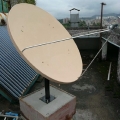
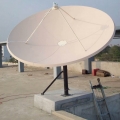
- Concrete Base Mounting: For rooftops or open plazas, it is recommended to construct a reinforced concrete foundation measuring at least 1.5m x 1.5m and 25cm in height (concrete grade no lower than C30). After positioning the cross-channel steel base and ensuring it is perfectly vertical, secure it firmly using eight M12×120 expansion bolts.
- Ballasted Frame Installation: For scenarios where roof waterproofing cannot be compromised or concrete foundations cannot be poured, Hwadar's dedicated ballasted frame can be used. This frame is typically welded from 60x60 angle steel and 8-gauge channel steel (dimensions usually 2m x 2m). During installation, the antenna's cross-base is bolted to the central channel steel of the frame, and 1.5 to 2 tons of ballast (such as metal blocks or stones) are evenly distributed across the frame to provide sufficient wind load resistance.
In summary, Hwadar fiberglass satellite antennas, with their high-precision SMC reflectors and superior corrosion and wind load resistance, represent an ideal choice for satellite reception systems in complex climatic environments. Strict adherence to their installation specifications during selection and construction will maximize the long-term stability of the receiving link.